
Boiler Service & Breakdowns
Annual servicing that keeps your warranty valid, and straight fault-finding when the heating or hot water goes down.
From £79 — a standard annual service
Gas Safe registered · London & surrounding areas
A service is more than a look and a wipe. We check the gas rate and burner pressure against the manufacturer's figures, analyse the flue gases, check the seals, the condensate, the expansion vessel charge and every safety device, then clean what needs cleaning.
It matters for two reasons. Nearly every manufacturer warranty requires an annual service to stay valid — and most of the breakdowns we get called out to in January were already visible in October.
On a breakdown we diagnose first and tell you what the repair costs before we do it. That includes the honest answer when a boiler is old enough that another repair is money after bad.
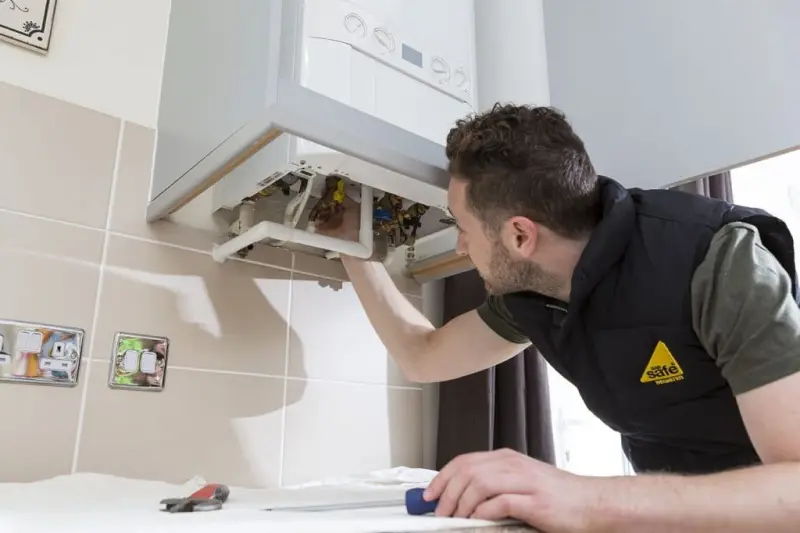
What’s included
- Gas rate and burner pressure checked against the manufacturer's specification
- Flue gas analysis and a full check of the safety devices
- Seals, heat exchanger, condensate trap and expansion vessel checked and cleaned
- System pressure and controls checked
- Written service record for your warranty
- Any fault explained and priced before the work starts
Add a CP12 in the same visit for £119 the pair. Any part a service turns up is priced and agreed with you before it is fitted.
How long it takes
- Annual boiler service
- 45 to 60 minutes
- Fault diagnosis
- Usually within the first hour on site
- Common repairs
- Same visit, if the part is on the van
Typical durations for an average London property. We confirm yours at the survey, along with a fixed written price.
What a real service includes, and what a fifteen-minute one skips
A service is not a visual inspection with a sticker at the end. The appliance case comes off. The burner, the heat exchanger and the condensate trap are inspected and cleaned. The case seal is checked, because on a room-sealed appliance that seal is what keeps combustion products out of your house. The flue is checked along its whole visible length and at its terminal. Ventilation to the appliance is checked, which matters most in the cupboards and conversions where somebody has since boarded a grille over.
Then it is measured. A flue gas analyser reads the combustion — carbon dioxide, carbon monoxide, and the ratio between them — and those numbers are compared against what the manufacturer specifies for that appliance. The gas rate is checked against the data plate, and the working pressure is read at the appliance with the boiler running hard. Those readings are the service. An engineer who did not take the case off did not do one.
The faults we actually find, in rough order of frequency
A blocked condensate trap or pipe, which stops the boiler and looks like a major fault. A pressure loss the owner has been topping up weekly for months, which is a leak somewhere and often a failed expansion vessel rather than a pipe. A diverter valve that has stopped moving cleanly, so the heating warms up whenever a hot tap is run. A pump that still spins but no longer shifts water through a silted circuit. A flue seal perished at the joint. Ventilation blocked by somebody's refurbishment.
Very few of these are the boiler failing. Most are components around it, or the system it sits on, and knowing which is which is the whole value of the visit. Replacing a working boiler because the diverter valve stuck is an expensive way to have the same problem in a newer case.
When repair stops being the sensible answer
Three signals together, not one alone. First, parts availability: manufacturers support appliances for a limited period, and once a heat exchanger or a control board is no longer obtainable the next fault is terminal whatever you spend now. Second, repair history: three repairs in two years is a pattern, not bad luck. Third, the heat exchanger itself — corrosion or persistent kettling there is the expensive component telling you it is near the end.
None of those on its own means replace. All three together, on a boiler over about twelve years old, means the money is better spent on a planned replacement in September than on an emergency in January. We will say which of the three we are looking at, and we will say when the honest answer is that it has years left in it.
What moves the price on a job like this
We give a fixed written price after the survey. These are the things that make one quote differ from another for what looks like the same work.
- Whether it is a service or a diagnosis
- A service is a defined piece of work. Chasing an intermittent fault is not, and we agree how long to spend before starting.
- Parts, and whether they still exist
- Common components are stocked and same-day. An obsolete part may not be obtainable at any price, which changes the conversation.
- How accessible the appliance is
- A boiler behind a fitted cupboard door is straightforward. One boxed in behind a bath panel is not.
- How many appliances
- A boiler, a fire and a hob checked in one visit cost less than three visits.
How it works
- 01
Call us
Tell us the boiler make and any fault code on the display — it usually tells us what we are coming to and which part to bring.
- 02
Diagnosis
We find the actual fault rather than swapping parts until something works.
- 03
Priced before we start
You hear what the repair costs, and whether it is worth doing on a boiler of that age, before we touch it.
- 04
Tested and recorded
Service or repair, it gets tested properly and you get a written record for the warranty.
Questions we get asked
How often should a boiler be serviced?
Once a year. Most manufacturer warranties require it. And a landlord's gas safety check is not the same thing — that is a safety inspection, not a service.
My boiler has stopped — what should I check first?
The pressure gauge (below about half a bar cold and it will lock out), the thermostat and timer, and whether there is a fault code on the display. Tell us the code when you call and we usually know what we are coming to.
Is it worth repairing an old boiler?
Sometimes. If parts are still available and the repair is modest against the age of it, repair. When the same boiler has needed three visits in one season, we will say so rather than keep charging you.
Do you do landlord gas safety certificates too?
Yes, and they are issued the same day. A service and a CP12 are two different jobs, and we are happy to do both in one visit.
Guides on this topic
Where this comes up in London
The most useful first service is on a flat nobody has looked after properly — the converted terraces of Hackney, Haringey and Lambeth, where the appliance has been signed off cheaply for years. What we find is rarely the boiler: it is a flue seal, a boarded-over ventilation grille from somebody's refurbishment, or a system that has never once been balanced.
Other things we do
- New Boiler InstallationCombi, system and regular boilers supplied and installed by Gas Safe registered engineers — with manufacturer warranty registration.
- Full Central HeatingComplete heating systems fitted from scratch: boiler, pipework, radiators, controls and commissioning.
- Megaflo & Unvented SystemsHigh-pressure hot water for busy homes. Unvented cylinder installation, servicing and G3 certification.
- Power FlushingSludge and debris removed from your system so radiators heat evenly again and your boiler stops working overtime.
- Under Floor HeatingWet underfloor heating zoned, balanced and pressure-tested before the screed goes down — on its own or alongside radiators.
Get in touch
Fastest way to reach us is a call or WhatsApp — send a photo of the job and we will come back with a price. Prefer email? Use the form and we will reply as soon as we are off site.